
Roof Repair vs. Replacement: Which One Actually Saves You Money?
Is it cheaper to repair or replace a roof? The short answer: repair is cheaper upfront, but replacement often costs less over time — especially on an older or heavily damaged roof. Here’s a quick breakdown to help you decide:
| Situation | Better Choice |
|---|---|
| Roof is under 15 years old with localized damage | Repair |
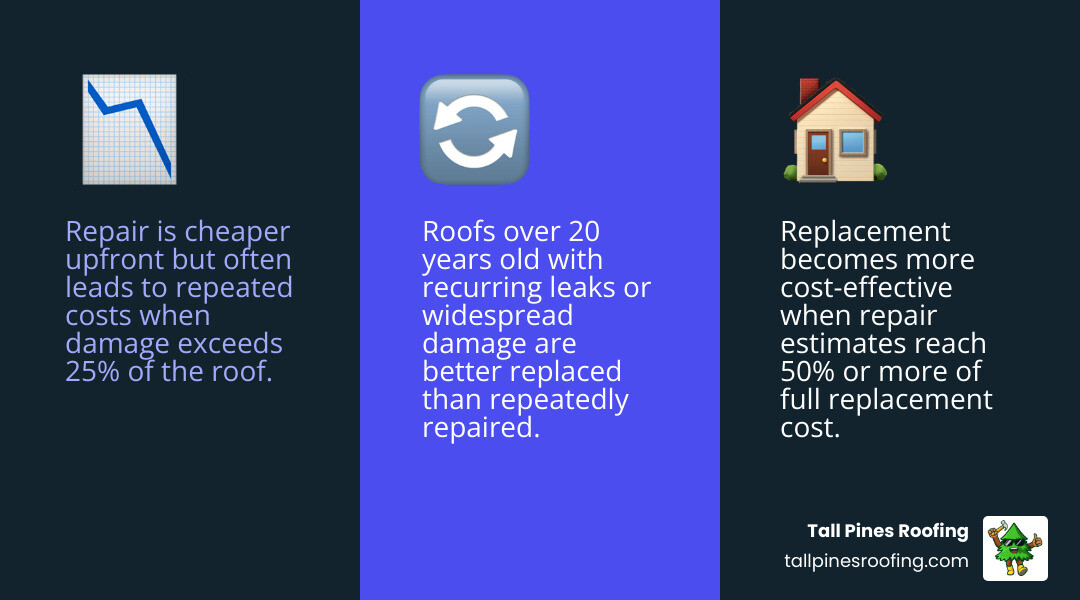
| Damage covers more than 25% of the roof surface | Replace |
| Repair estimate exceeds 50% of replacement cost | Replace |
| Roof is 20+ years old with recurring leaks | Replace |
| Minor issue like a single flashing failure or missing shingles | Repair |
| Multiple leaks appearing in different areas | Replace |
The decision isn’t always obvious. A water stain on the ceiling or a few missing shingles after a storm can feel like a minor fix — until a contractor opens things up and finds rotted decking, failed underlayment, or mold working its way through your attic. In Rochester’s climate, where freeze-thaw cycles, heavy snow loads, and ice dams push roofs hard every single winter, what looks like a small problem on the surface can mask something much more serious underneath.
That’s why getting this decision right matters. A repair on the wrong roof doesn’t just delay the inevitable — it can quietly add thousands of dollars in compounding damage before you’re forced into a full replacement anyway.
I’m Matthew Hebert, founder of Tall Pines Roofing and a roofing professional with over two decades of experience in the industry. Having helped thousands of homeowners in the Rochester area navigate exactly this question — is it cheaper to repair or replace a roof — I’ve seen how the wrong call in either direction costs people real money. This guide gives you the same honest framework I use with every homeowner I work with.
Basic is it cheaper to repair or replace a roof terms:
- I need to find a roof repair company in Rochester, NY for a few missing shingles.
- how to decide between patching and replacing a roof
Is It Cheaper to Repair or Replace a Roof? The Core Decision Framework
When evaluating whether is it cheaper to repair or replace a roof, we look at a strategic decision framework. Rather than guessing, we rely on three mathematical and physical rules of thumb to guide our recommendations.
- The 25% Rule: This is a structural and regulatory standard. If the damaged area covers more than 25% of your total roof surface, localized repairs are no longer practical or legally compliant in many building codes. At this stage, a full replacement is the only logical path forward.
- The 50% Rule: If a single repair quote exceeds half the total value of a complete replacement, investing in the repair is a poor financial decision. You are better off putting those funds toward a brand-new system that comes with a fresh warranty.
- The 30% Rule: Many experienced contractors use this as a tighter threshold. If the immediate repair costs more than 30% of a full replacement, the remaining lifespan of your current roof is rarely long enough to justify that upfront expense.
Understanding these thresholds helps you determine whether you are buying meaningful time or simply delaying an inevitable project. If you are struggling to diagnose the scale of your damage, check out our guide on How to Tell If You Need a New Roof or Just a Band-Aid to help clarify your next steps.
When Localized Damage Makes Repair the Better Option
There are plenty of scenarios where a repair is absolutely the right financial move. If your roof is relatively young and the damage is highly localized, there is no reason to undergo a complete tear-off.
For example, a single leaky pipe boot, a loose piece of chimney flashing, or a small patch of shingles lifted by a windstorm can usually be resolved with a targeted repair. These issues are surface-level and do not indicate that the broader roofing system is failing. Addressing these minor problems immediately prevents water from reaching your attic and decking, allowing you to easily squeeze another decade of performance out of your existing roof. To learn more about managing these minor fixes efficiently, read our tips on how to Stop the Drip Without Breaking the Bank.
When Systemic Failure Means Replacement is More Cost-Effective
On the other hand, attempting to repair a systemically failing roof is like trying to patch a sinking boat with tape. If your roof has multiple active leaks in different rooms, sagging sections, or widespread shingle degradation, a repair will only act as a temporary band-aid.
Systemic failure typically involves the underlying components of your roof. When water gets past the shingles and compromises the underlayment, it begins to rot the wooden roof decking beneath. Once the structural decking loses its integrity, shingles can no longer hold fasteners securely, and the entire system becomes unsafe. In these situations, continuing to pay for individual repairs is a waste of resources. If you are experiencing recurring issues, it is time to recognize When Roof Repair Just Isn’t Enough Anymore.
Key Factors Influencing Your Roofing Decision
Deciding whether is it cheaper to repair or replace a roof requires looking beyond the immediate damage. Several physical characteristics of your home and roofing system dictate which option makes the most financial sense.
- Roof Slope and Complexity: Steeper roofs and complex designs with multiple valleys, dormers, and intersections require more labor and specialized safety equipment. On a highly complex roof, repairing a single valley can be incredibly labor-intensive, making replacement a more attractive long-term investment.
- Structural Integrity: If your rafters or roof decking have begun to sag due to prolonged moisture exposure, repairs cannot fix the underlying issue. The structural framework must be repaired, which requires removing the existing roofing material entirely.
- Ventilation and Insulation: An improperly ventilated roof traps heat and moisture in your attic, baking your shingles from the inside out and causing premature failure. If your roof is failing because of poor ventilation, a replacement allows us to correct the ventilation design, whereas a repair simply leaves the destructive cycle in place.
To dive deeper into the physical elements that dictate your roof’s longevity, read about The Main Factors That Determine Your Roof’s Expiration Date.
How Roof Age Determines If Is It Cheaper to Repair or Replace a Roof
The calendar is often the most honest advisor when it comes to your roof. Most standard asphalt shingle roofs have a realistic lifespan of about 20 years.
We highly recommend applying the 75-80% lifespan rule. If your asphalt roof is 15 to 18 years old, it has entered its twilight years. At this stage, the asphalt has lost its flexibility, the granules have washed away, and the shingles are brittle. Spending money to repair a roof in this condition is highly inefficient because a new leak is likely to develop elsewhere during the next heavy storm. If your roof is approaching this milestone, discover Why Your 20-Year-Old Roof Might Be a Money Pit.
How Material Longevity Affects Whether Is It Cheaper to Repair or Replace a Roof
Different roofing materials behave differently over time, which directly shifts the repair-versus-replace equation.
- Asphalt Shingles: While they are the most common and cost-effective option upfront, they have the shortest lifespan. If an asphalt roof has localized damage early in its life, repair is a no-brainer. But as it ages, replacement becomes necessary quickly.
- Metal Roofing: Known for incredible durability, a metal roof can easily last 40 to 70 years. Because the material itself lasts so long, repairing localized issues like failed fasteners or minor flashing leaks is almost always preferred over replacement.
- Slate and Tile: These premium materials can last anywhere from 50 to over 100 years. If you have a slate roof with a few broken tiles, replacing those specific pieces is highly cost-effective, provided the underlying underlayment is still in good condition.
To compare how different materials hold up over the decades, take a look at our comprehensive breakdown of The Lifespan of Every Major Roofing Material.
Long-Term Financial and Insurance Considerations
| Financial Metric | Roof Repair | Full Roof Replacement |
|---|---|---|
| Upfront Investment | Low | High |
| Lifespan Added | Short-term (2-5 years) | Long-term (25-50 years) |
| Home Resale Value Impact | Minimal to none | High (Recoups a major portion of investment) |
| Energy Efficiency | No change | Improved (Modern underlayments & reflective shingles) |
| Warranty Coverage | Limited to repair area | Comprehensive material & workmanship warranties |
When deciding on the future of your roof, you must weigh immediate cash flow against long-term financial security. While a replacement requires a larger initial commitment, it often resolves recurring costs and protects your home’s equity. If you are worried about the financial impact of a major exterior project, explore our analysis: Will a New Roof Break the Bank?.
The Cumulative Cost of Repeated Repairs
One of the most common traps homeowners fall into is “the patchwork problem.” It is easy to justify a small repair this year, another next year, and another the year after that.
However, these cumulative costs add up quickly. Even worse, while you are busy patching visible leaks, water may be slowly migrating through your roof system, leading to hidden wood rot, ruined attic insulation, and hazardous mold growth. Mold remediation and structural wood replacement can easily dwarf the cost of a standard roofing project. If you find yourself calling a contractor every autumn, you are likely dealing with The Patchwork Problem: Knowing When Your Roof Needs More Than a Band-Aid.
Maximizing ROI and Energy Efficiency
A full roof replacement is not just an expense; it is an investment that yields tangible returns. From a resale perspective, a brand-new roof is a massive selling point that increases buyer confidence and allows you to recoup a significant percentage of the project’s value when you sell your home.
Additionally, modern roofing systems are designed with energy efficiency in mind. Advanced underlayments, proper intake and exhaust ventilation, and high-performance shingles help regulate your attic’s temperature. In Rochester’s freezing winters, this prevents heat from escaping your home and minimizes the risk of ice dams. In the summer, it keeps your home cooler, reducing strain on your air conditioning system. To model your long-term savings, you can Calculate the Cost of a Roof Replacement and see how a modern system pays dividends over time.
Frequently Asked Questions About Roof Repair and Replacement
Can I install a second layer of shingles to save money?
While installing a second layer of shingles (often called a re-roof or overlay) is legally permissible in some areas, we rarely recommend it. Overlaying new shingles over old, curled, or damaged shingles prevents the new layer from laying completely flat, which shortens its lifespan.
Furthermore, an overlay completely hides the underlying roof decking. If there is rotted wood or active water damage beneath your old shingles, installing a second layer traps that moisture and accelerates structural decay. Additionally, the double layer adds immense weight to your home’s structure and can void the manufacturer’s warranty on your new shingles.
Does homeowners insurance cover a full roof replacement?
Homeowners insurance is designed to cover sudden, accidental damage caused by covered perils, such as severe windstorms, hail, fallen trees, or fires. If a major storm damages a significant portion of your roof, your policy will likely cover the replacement, subject to your deductible.
However, insurance policies strictly exclude coverage for normal wear and tear, aging, or damage resulting from deferred maintenance. If your roof is simply old and has reached the end of its natural lifespan, your insurer will not pay for a replacement. It is crucial to document storm damage immediately and work with a certified contractor to ensure your claim is filed correctly.
How can I extend the lifespan of my current roof?
The best way to avoid premature roof replacement is through consistent, proactive maintenance. Keeping your gutters clean is essential; clogged gutters cause water to back up under your lower shingles, rotting the roof edge.
You should also trim overhanging tree branches to prevent them from scraping your shingles or falling during high winds. Regularly inspect your roof for moss or algae growth, and address minor shingles issues before they turn into active leaks. For more practical maintenance strategies, check out our guide on 5 Simple Ways to Make Your Roof Last Decades Longer.
Conclusion
Determining whether is it cheaper to repair or replace a roof comes down to an honest assessment of your roof’s age, the extent of the damage, and your long-term goals for your home. While a quick patch can buy you time on a young, healthy roof, continuing to repair an aging system is a costly cycle that threatens your home’s structural integrity.
At Tall Pines Roofing, we believe in giving Rochester homeowners straightforward, honest advice. We back our work with the Tall Pines Guarantee, which promises superior craftsmanship, real-time project updates, a comprehensive 30-year warranty, and a commitment to leaving your property cleaner than we found it.
Don’t let a minor leak turn into a major headache. Schedule a professional roof assessment with Rochester’s trusted experts today, and let us help you make the smartest, most cost-effective decision for your home.
